| From Chips to AI: Exploring the Lifeline of Artificial Intelligence [message #52] |
Thu, 30 July 2026 08:25 |
 |
 admin
admin
Messages: 275
Registered: July 2026
|
Senior Member
Administrator |
|
|
Microsoft and Oracle announced on the 9th of May 2023 a discussion on sharing server resources to avoid shortages. You are reading correctly; the unlimited on-demand cloud has fundamental limitations. How have we come so far?
https://upload.wikimedia.org/wikipedia/commons/thumb/1/10/Wi kimedia_Foundation_Servers-8055_23.jpg/320px-Wikimedia_Found ation_Servers-8055_23.jpg
To be fair to Microsoft and Oracle, the real cause is a complex geopolitical involving Taiwan, high-tech semiconductors and artificial intelligence, and the next realm of technology.
This battle for technological supremacy has all the ingredients of a new cold war between the USA and China, with Taiwan in the middle (some of you still remember the Cuban missile crisis in 1962). However, nuclear nukes are not the main ingredient, but a small cutting-edge technology piece: semiconductors.
Unlocking the Secrets of Silicon: How Semiconductors Changed Everything
The story of semiconductors began with humble dreams etched on silicon wafers. William Shockley, John Bardeen, and Walter Brattain developed the first working transistor. In 1947, the transistor was invented at the Bell Laboratories; this tiny device, crafted from germanium, eventually revolutionized electronics by replacing bulky vacuum tubes with compact, energy-efficient components.
In the 1960s, integrated circuits (ICs) emerged, allowing multiple transistors to be etched onto a single silicon chip. Jack Kilby of Texas Instruments and Robert Noyce at Fairchild Semiconductor independently developed the integrated circuit, combining multiple transistors on a single chip.
The integrated circuit pushes computing power into an exponential curve, allowing engineers to transform complex systems into chips to perform logical operations.
Moore's Law, coined by Intel co-founder Gordon Moore in 1965, became the guiding principle.
Gordon Moore and Robert Noyce at Intel in 1970 - Wikipedia
Moore wrote an article to forecast the future of semiconductor components from 1965 to 1975, in which he predicted:
Moore's Law
“the complexity of integrated circuits would double approximately every year, making electronics almost inexpensive” G. Moore 1965
This law became a self-fulfilling prophecy, propelling semiconductor research and manufacturing forward with tremendous momentum and pushing the industry into an exponetial grow.
https://upload.wikimedia.org/wikipedia/commons/thumb/0/00/Mo ore%27s_Law_Transistor_Count_1970-2020.png/640px-Moore%27s_L aw_Transistor_Count_1970-2020.png
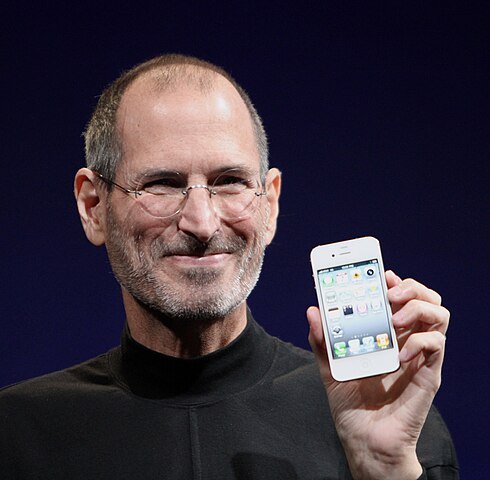
Semiconductors soon permeated every aspect of modern life, powering personal computers and transforming them from room-sized monoliths to portable machines, like iphones.
https://upload.wikimedia.org/wikipedia/commons/thumb/b/b9/St eve_Jobs_Headshot_2010-CROP.jpg/490px-Steve_Jobs_Headshot_20 10-CROP.jpg
Lately, the field of computer sciences has focused on more intelligent and autonomous systems, artificial intelligence (AI).
Semiconductors provide the computational power to process massive amounts of data, learn patterns, and make intelligent decisions. Convolutional Neuronal Network model (CNN) are a fundamental piece of Artificial Intelligence tools and they are made of a network of tensors and once they have been traind CNNs can identify objects in images.
Convolutional Neuronal Network model (CNN)
In the second part I will explain more in detail the AI wonders and how a handful of companies dominate the semiconductor market leading the world to the edge of a cold war.
|
|
|
|

 Search
 Help
Help Members
 Register
 Login
Login Home
Home